

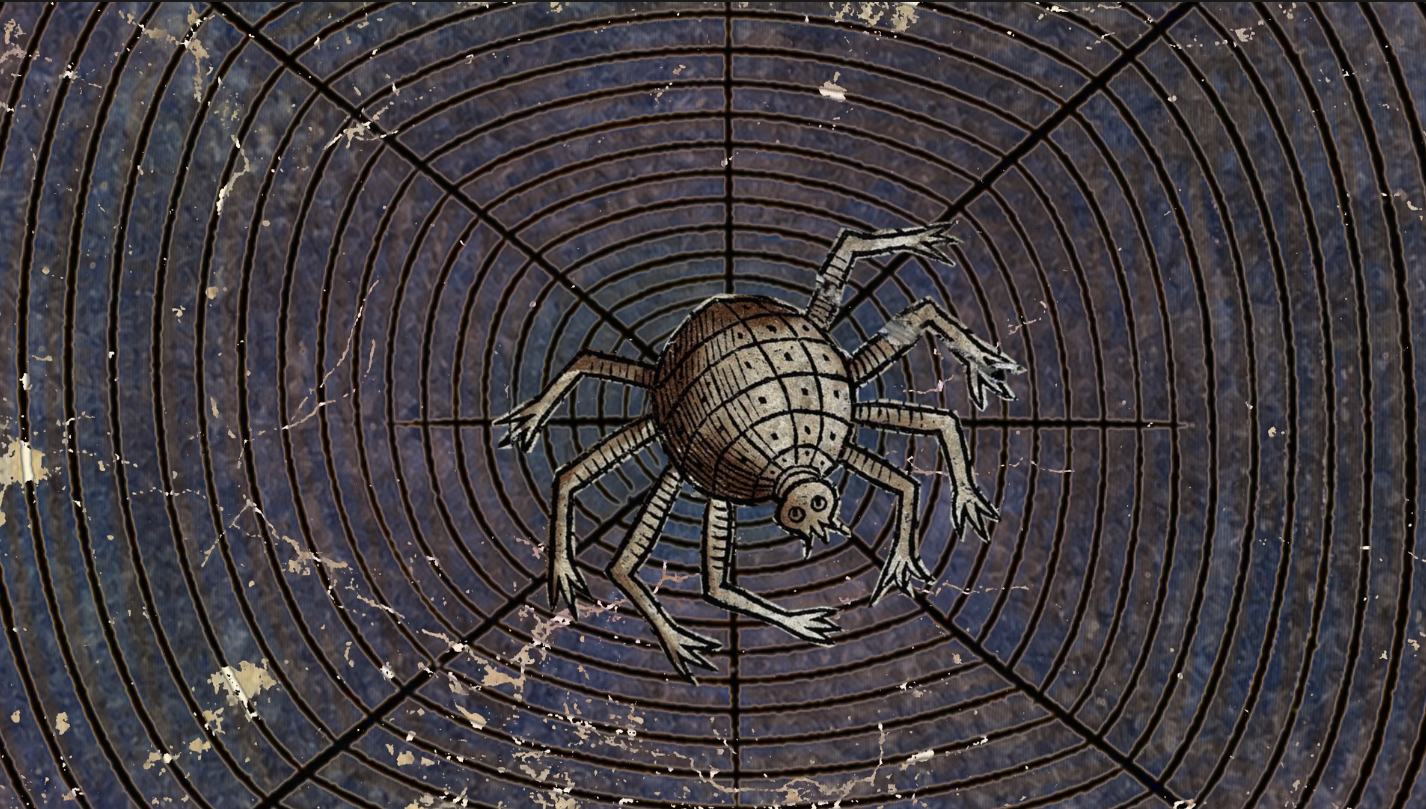
There is something at once unsettling and beautiful in the way a spider works. It spins thread from its own body, out of nothing stretches a construction of mathematical precision, and then holds still, patiently, at its center. No wonder that for millennia humankind has seen in this creature something more than an insect. The spider became an image of creation, of destiny, of intelligence and of the order of the world. In nearly every culture that watched it long enough, it rose to the rank of a deity, an ancestor, or a teacher.
This text is a journey through the spider myth, from the weaver goddesses of antiquity to a contemporary, animist approach. What can we, as modern people, still learn from it?
The creature that spins the world from itself
Let us begin with what makes the spider such an exceptional symbol. It does not build from materials it finds around it, but it creates the building material from its own interior. The web is born from the spider’s body and expresses outward a structure that already existed within it.
Thanks to the web, empty space becomes an ordered and functional territory. The thread carries information from every point of the web to its center, and each fiber fulfills a specific role within the whole. This is why so many traditions read the spiderweb as an image of the universe, in which everything is connected to everything else, and every action gives rise to consequences carried along invisible threads. The spider teaches that to create a world is to establish bonds, to sustain a structure, and to give reality its shape.
The spider in myth: spinning as a sacred act
Across the world’s mythologies the spider wears many faces. In one place it is a creator and primordial mother who spins the first people into being; in another, a cunning trickster who wins the world’s stories through wit; elsewhere a weaver whose skill rises to challenge the gods themselves, or a guide of the dead keeping watch on the threshold between worlds. What binds these figures is not a single divine role but a single gesture, the act of spinning, of drawing a whole ordered world out of oneself. For thousands of years weaving and spinning were labors of a deeply sacred dimension, and wherever a culture watched the spider closely, it recognized in that patient, self-made web an image of how reality itself is made.
Greece gave us the most famous of the spider tales, the myth of Arachne. A young weaver from Lydia becomes so accomplished in her craft that she dares to challenge Athena, goddess of wisdom and weaving. The decisive detail is this: Arachne does not weave a pious praise of the gods, but depicts their abuses, deceptions, and acts of violence. Her work is perfect and, at the same time, deeply uncomfortable. Athena cannot fault her for any lack of skill, so she tears the tapestry apart, and in doing so punishes the girl for having used art to speak a dangerous truth. The transformation into a spider makes Arachne an absolute weaver, condemned to spin forever. It is a beautiful myth about the price of creating from the margins, about an intelligence that challenges power through the very precision of its work.
In West Africa, especially among the people of present-day Ghana, there lives the myth of the trickster spider Anansi, who always triumphs not through strength but through intelligence, cunning, and mastery over the word. One of the most famous tales explains how all the stories of the world came to humankind: they belonged to the sky god Nyame, and Anansi won them by capturing, through trickery, a series of dangerous creatures. As his reward he received all the stories of the world, which from then on bear the name the stories of Anansi. Anansi symbolizes the human ability to win victories despite an opponent’s advantage. This myth makes the spider the master of narrative knowledge, for his true web is woven of words.
Among the Indigenous peoples of the southwestern United States (the Hopi, the Navajo, and related peoples) appears Spider Grandmother, one of the fundamental beings at the beginning of humankind. In some versions she molds the first people from clay and breathes life into them with a divine breath; in others she teaches them weaving, agriculture, medicine, the organization of community, and the laws needed to maintain balance between the worlds. Here the web becomes the fabric of existence, joining humans with animals, with ancestors, with spirits, and with the earth. Spider Grandmother is the principle of interdependence: reality is an immense web of relations in which every action adds a new thread to the fabric of the world, and to live means to take part in preserving that great, shared warp.
In pre-Columbian Mexico the spider carried an entirely different meaning. In the symbolism of the peoples of central Mexico it belonged to the creatures of darkness (alongside the jaguar and the owl), beings of caves, of night, and of the moist earth, and therefore naturally associated with the underworld and the realm of the dead. Spider imagery appears in the murals of Teotihuacan, where it accompanies a deity linked with the earth, water, and the beyond. Some scholars have read this figure as a Spider Goddess, and the spider itself, hanging from its thread, as an image of the souls’ passage between the levels of existence; it must honestly be added, however, that this interpretation remains contested and does not command full scholarly agreement. What is certain is that the spider endured in the imagination of these cultures as a being of thresholds and a dweller on the border between what is visible and what is hidden. And it was precisely this belonging to two worlds that made it a figure of passage.
The philosophy of the web: from the Upanishads to animism
The logic of the spider did not stop at myths. One of the oldest examples comes from the Upanishads, the foundational philosophical texts of Hinduism. In them we read that the Absolute produces the universe exactly as a spider spins its web: the thread issues from its body, unfolds into a complete structure, and is finally drawn back in by the one who created it. This image explains, all at once, the origin of the world, its endurance, and its disappearance: creation as a ceaseless process of emanation and reabsorption.
And here we arrive at the most important question: what of all this remains for us, here and now?
Perhaps this is exactly the spider’s lesson for our own age, so proud of its networks: informational, social, and technological. The spider knew something about the web that we are still learning: that no life exists in isolation, that the faintest tremor runs through the entire fabric, and that to create means to take responsibility for every thread we add to the world. The spirit of the spider never departed along with the old myths. It still weaves, patiently, in the corner we rarely look into. We need only pause, and feel the trembling of the thread.
To attune yourself as fully as possible to the energy of the patient and creative spider spirit, I invite you to the meditation I composed to round out this vast theme:
Leave a Reply